Tanah Lot Temple is one of the most sacred temples (places of worship for Hindus) in Bali, Indonesia. Here there are two temples that are positioned on a large rock. One is located on top of a boulder and the other is located on a cliff comparable to Uluwatu Temple. Tanah Lot Temple is part of the Dang Kahyangan temple. Tanah Lot Temple is a sea temple where the gods who guard the sea worship. Tanah Lot is famous as a beautiful region to watch the sunset.
History
The records of the Tanah Lot Temple in Bali Indonesia is based on legend, told in the 15th century, Bhagawan Dang Hyang Nirartha or recognized as Dang Hyang Dwijendra carried out a mission to spread Hinduism from Java to Bali.
At that time the ruler on the island of Bali was Raja Dalem Waturenggong. He warmly welcomed Dang Hyang Nirartha’s arrival in carrying out his mission, so that the spread of Hinduism made it to remote villages on the island of Bali.
In the history of Tanah Lot, it is instructed that Dang Hyang Nirartha saw the holy light from the direction of the southern sea of Bali, so Dang Hyang Nirartha looked for the location of the mild and he arrived at a beach in a village called Beraban Tabanan village.
At that time the village of Beraban was led by Bendesa Beraban Sakti, who strongly opposed the teachings of Dang Hyang Nirartha in spreading Hinduism. Bendesa Beraban Sakti, adheres to monotheism.
Dang Hyang Nirartha reflected on a rock that resembled the shape of a parrot that was originally on land.
In various ways, Bendesa Beraban wanted to expel Dang Hyang Nirartha from his meditation place.
According to the records of Tanah Lot, based on the legend of Dang Hyang Nirartha, moved the rock (his place of meditation) to the middle of the beach with spiritual power. The rock is named Tanah Lot, which capacity a rock in the middle of the ocean.
Since that incident, Bendesa Beraban Sakti recognized Dang Hyang Nirartha’s supernatural powers via becoming his follower to embrace Hinduism alongside with all local residents.
It is told in the history of Tanah Lot, before leaving Beraban village, Dang Hyang Nirartha gave a keris to the Beraban village. The keris has the power to dispose of all diseases that attack plants.
The keris is stored at Puri Kediri and a religious ceremony is made at Tanah Lot Temple every six months. Since this is automatically done by the villagers of Beraban, the welfare of the population has greatly increased with plentiful agricultural crops and they live with mutual respect.
Legend
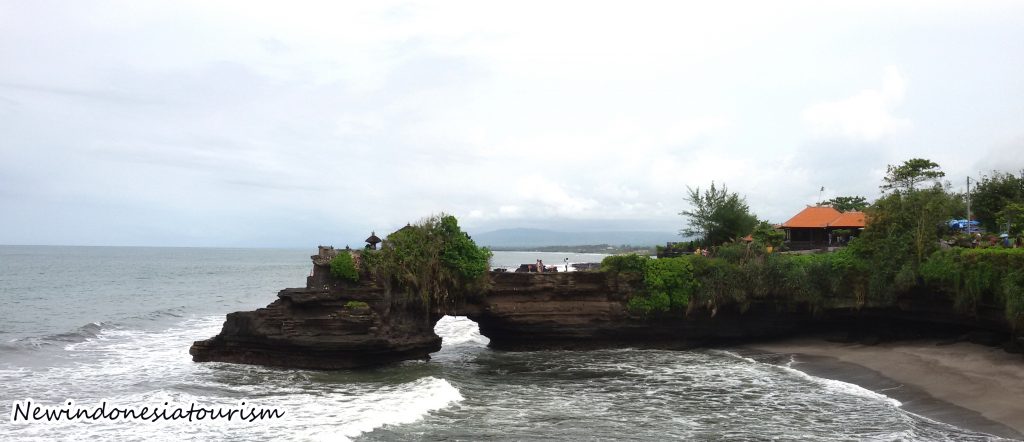

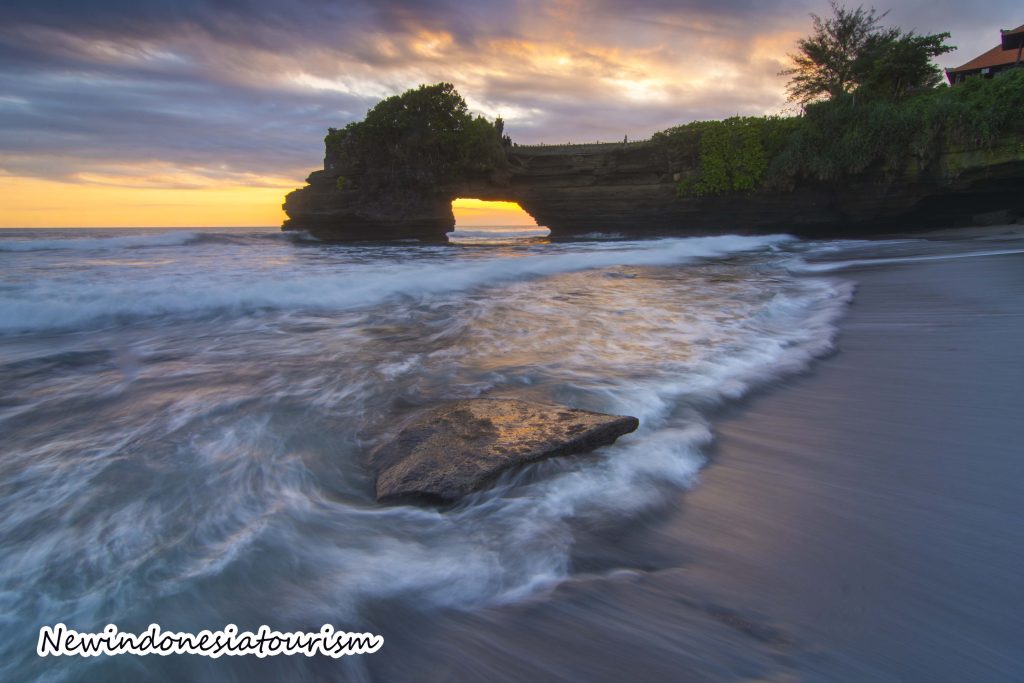
According to legend, this temple was built through a brahmana who traveled from Java, namely Danghyang Nirartha who succeeded in strengthening the belief of the Balinese people to Hindu teachings and built the Sad Kahyangan in the 16th century. At that time, the ruler of Tanah Lot named Bendesa Beraben was once jealous of him because his followers began to go to follow Danghyang Nirartha. Bendesa Beraben then ordered Danghyang Nirartha to leave Tanah Lot. Danghyang Nirartha agreed, but earlier than that he with his strength moved the Stone Block to the middle of the beach (not to the middle of the sea) and built a temple there. He also turned his scarf into a temple guard snake. This snake still exists today and scientifically this snake includes a kind of sea snake that has the characteristics of a flat tail such as fish, black with yellow stripes and has a poison 3 times stronger than cobra snakes. Finally it is mentioned that Bendesa Beraben grew to become a follower of Danghyang Nirartha.
renovation
Tanah Lot Temple has been disturbed by abrasion and erosion due to waves and wind. Therefore, the Bali government thru the Bali Coastal Protection Project installed a tetrapod as a breakwater and strengthened the cliffs around the temple in the form of artificial reefs. The vicinity around Tanah Lot has also been laid out considering the role of Tanah lot as a tourist vacation spot in Bali.
The first renovation was carried out since 1987 as a phase I protection project. At this stage, a two tonne wave breaker (tetrapod) was positioned in front of the Tanah Lot Temple. In addition, concrete banks and artificial walls were also constructed to protect against waves. However, the laying of tetrapods disturbed the beauty and natural beauty of the surrounding place so that a feasibility study was carried out involving religious leaders and local communities in 1989. The design of the breakwater shape below the surface of the water and the manufacture of artificial coral was made in 1992 and renewed again in 1998. Protection The temple commenced to be implemented around June 2000 and completed in February 2003 through a loan help from the Japan Bank for International Cooperation (JBIC) amounting to Rp95 billion. The entire work includes the building of Wantilan, Pewaregan, Paebat, Candi Bentar, arrangement of the parking area, and arrangement of roads and parks in the Tanah Lot area.